
Polk County Criminal Records
Criminal court records in Polk County are created when a criminal, traffic-criminal, or petty case is filed in Minnesota District Court. Polk County does not have a separate county court, municipal court, or justice court for criminal case files. The local trial court is Polk County District Court, part of the Ninth Judicial District, and Court Administration is the local records counter for certified copies and case-file questions.
A criminal court record is not the same thing as an arrest report. The court file starts with a complaint, citation, tab charge, or other filed charging document and then grows as the case moves through hearings, motions, pleas, orders, disposition, sentencing, probation, and financial obligations. The arrest side, including jail custody and controlling-charge details, belongs to the sheriff and the Northwest Regional Corrections Center. The narrower charge pathway is covered in the Polk County arrest records and court charges material, while this page keeps the focus on the full court case file.
The Minnesota Judicial Branch's court structure overview places District Court as the general trial court for felony, gross misdemeanor, misdemeanor, traffic, juvenile, civil, family, and probate matters. Appeals from Polk County District Court usually move to the Court of Appeals, not to a second county trial court. That matters for a Polk County criminal record search because the local criminal file should be checked through District Court systems first.
Search Polk Criminal Court Records
The main online route is Minnesota Court Records Online Case Search. MCRO covers public Minnesota District Court records, including Polk County criminal court records when remote access is allowed. The portal is useful for names, case numbers, citation numbers, attorneys, hearings, and public documents, but it is not the official certified record. Certified copies and civil judgment certifications come from local Court Administration.
- Open MCRO Case Search and accept the site terms before searching.
- Use a case number if one is known. Polk examples use the county code 60, such as 60-CR for criminal cases.
- If searching by name, filter to Polk County and the criminal case category where the portal allows it.
- Open the case register to read charges, events, hearings, orders, disposition, sentence, and payment history.
- Ask Polk County Court Administration for certified copies or for records that are public at the courthouse but not remote online.
MCRO has one key criminal-search limit. Pending criminal, traffic, and petty cases with no conviction may not return by defendant-name search, though they can still appear by case number. For conviction-level criminal history, use the Minnesota Public Criminal History Search from DPS/BCA rather than MCRO. BCA criminal history is a separate state channel, not a full Polk County court file.
The Minnesota public criminal history portal is the source shown in the manifest for the first criminal record image.
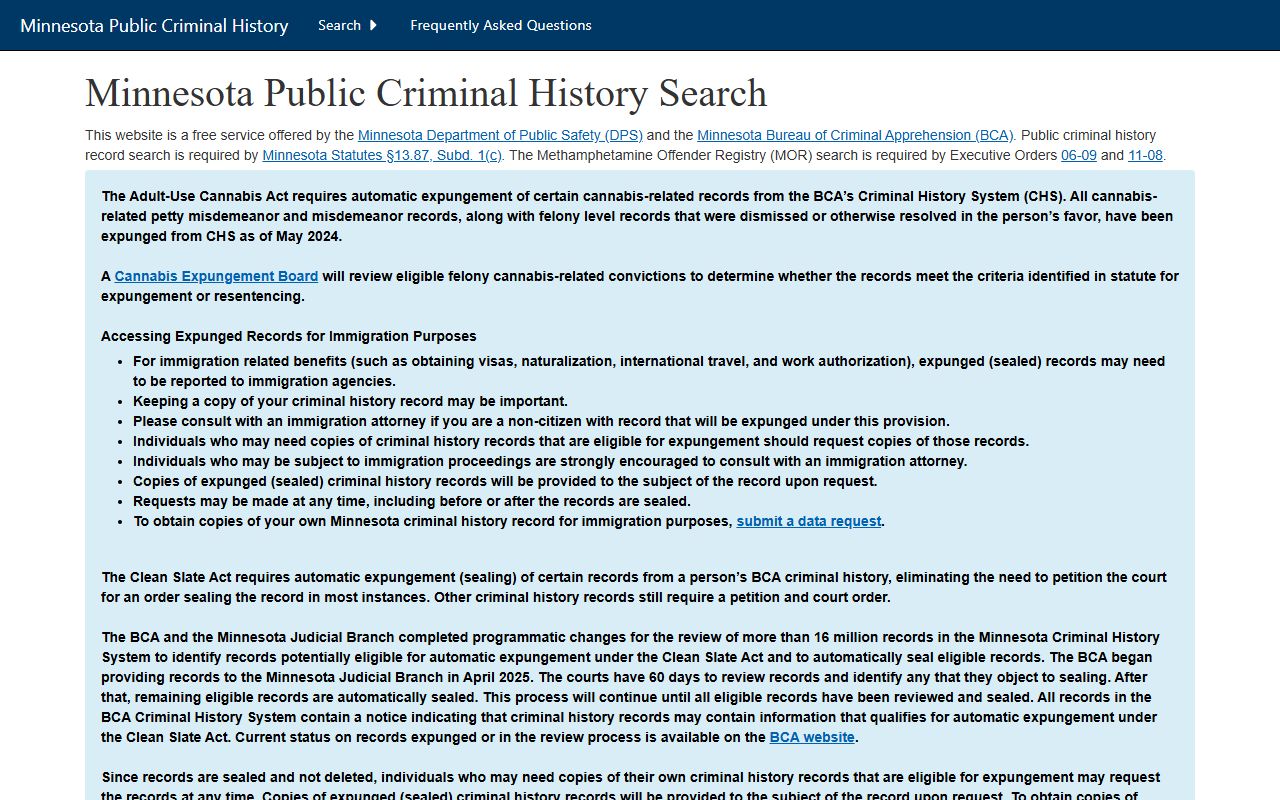
Use that public criminal history search for statewide conviction data, then use MCRO or Court Administration when the Polk County criminal court record itself is needed.
Polk Criminal Case Flow
A Polk County criminal case usually appears as a series of events on the register of actions. The first public entry may be a complaint or citation, followed by first appearance, arraignment, omnibus or pretrial hearings, motions, plea, trial setting, verdict, disposition, sentencing, probation events, and payment entries. Local calendar examples show hearing types such as Arraignment, First Appearance, Initial Appearance - Rule 8, Omnibus Hearing, Plea Hearing, Sentencing, and Probation Violation Hearing.
Case flow: Charges Filed › Arraignment › Pretrial and Motions › Plea or Trial › Disposition › Sentencing
| Stage | What the Polk County Record May Show |
|---|---|
| Charges filed | Complaint, citation, statute, severity, defendant, prosecutor, and case number. |
| Arraignment or first appearance | Rights, plea setting, custody status, bail or release terms, and next hearing date. |
| Pretrial or omnibus | Motions, evidentiary issues, settlement talks, scheduling, and court orders. |
| Plea or trial | Guilty plea, not guilty plea, verdict, dismissal, or amended count. |
| Disposition and sentence | Final outcome, jail or prison term, probation, fines, restitution, and conditions. |
Polk County court calendars can also help confirm courtroom, Zoom status, judicial officer, and hearing type. A calendar is not a full case file, and a missing calendar line does not cancel a hearing. Use the formal court notice or Court Administration for case-specific date questions.
Polk Criminal Record Fields
The case file gives more context than a simple charge row. A Polk County criminal court record may connect charges to hearings, orders, plea events, disposition, and sentence. Case numbers help identify the file type. In observed Polk examples, 60 is the county identifier, CR marks a criminal file, and VB marks violations bureau or traffic-style matters.
| Field | What It Shows |
|---|---|
| Case number | Minnesota file format such as 60-CR or 60-VB, with 60 tied to Polk County examples. |
| Parties | Defendant, prosecutor, victim-related protected fields when public, and attorney names where listed. |
| Charges | Alleged offense, statute, severity, and whether the charge was amended, dismissed, or resolved. |
| Hearings | Date, time, location, judicial officer, hearing type, and party connection type. |
| Register of actions | Chronological docket entries, filings, orders, warrants, probation events, and payment events. |
| Disposition | Final outcome for a count, such as guilty plea, dismissal, acquittal, or other court result. |
| Sentence | Jail, prison, probation, fines, fees, restitution, treatment terms, and other court-ordered conditions. |
The image from Minnesota Statutes section 13.87 ties Polk County criminal court records to public criminal history data rules.
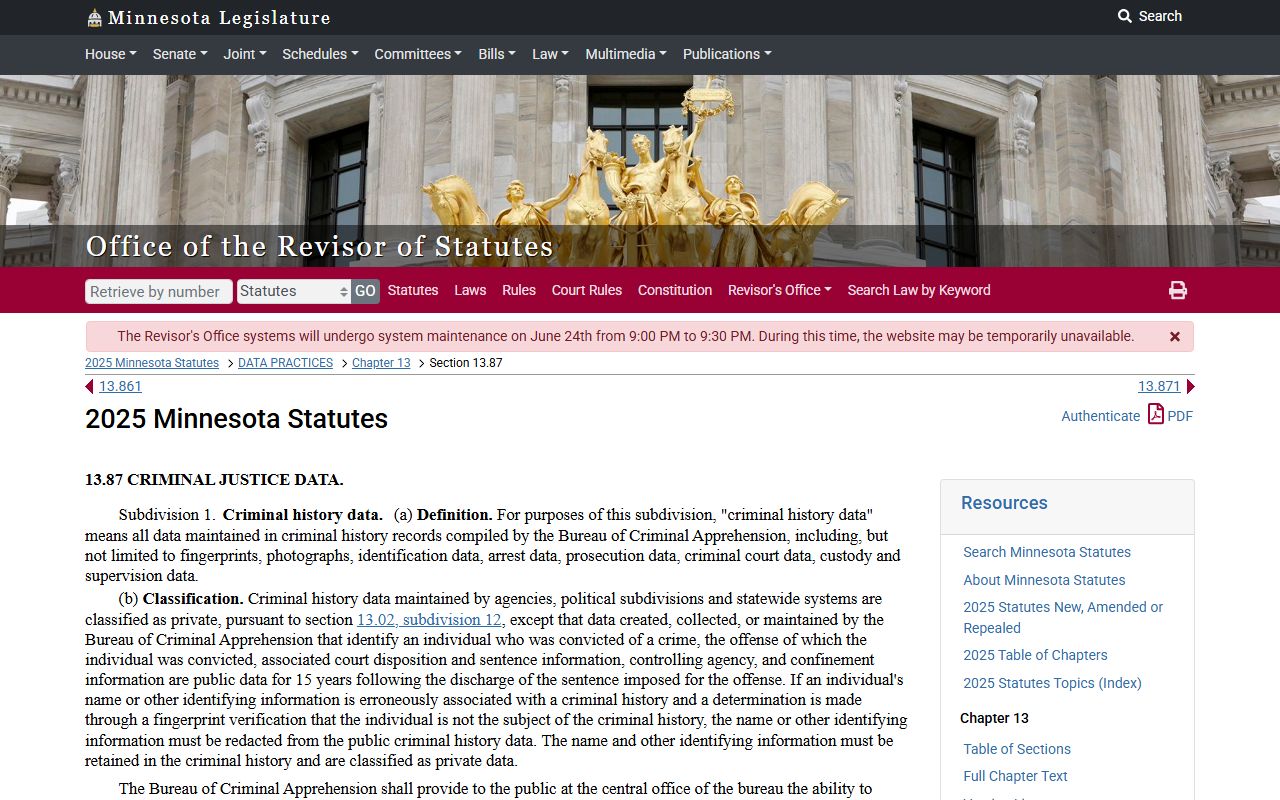
That law supports public criminal history access, but the Polk County case file still comes from District Court records and local Court Administration.
Polk Charges vs Convictions
A charge is an accusation filed in court. A conviction is a final court result based on a guilty plea, guilty verdict, or other finding that enters guilt. Polk County criminal court records may show charges that were dismissed, reduced, amended, stayed, or never led to conviction, so the charge list must be read with the disposition and sentence fields.
| Point | Charge | Conviction |
|---|---|---|
| Role in the file | Starts or frames the accusation. | Shows a final guilty outcome. |
| Where it appears | Complaint, citation, case register, and hearing entries. | Disposition, sentence, judgment, and BCA conviction history when public. |
| What to check | Statute, severity, amendments, and dismissal entries. | Plea or verdict, sentence, probation, fines, and restitution. |
For background research, this distinction is crucial. MCRO can show case activity and public documents, while BCA's public criminal history channel focuses on public conviction data under Minnesota law.
Note: Pending Polk County criminal cases may require a case number because name search can miss matters with no conviction.
Polk Dispositions and Sentences
Disposition means the court's result for a charge or case. Sentence means the penalty or conditions ordered after conviction. In Polk County criminal court records, both should be reviewed because a case may contain several counts with different outcomes. One count may be dismissed while another count has a plea, probation term, jail time, fine, or restitution entry.
Probation and violation events can continue after the first sentencing date. The Polk calendar examples include Probation Violation Hearing, Sentencing, Plea Hearing, and Omnibus Hearing. If a person is in custody, the NWRCC roster may show a controlling charge or hold, but it does not replace the court disposition. For custody status, use the Polk County inmate records page or contact the jail.
- Disposition
- The final result for a charge or case, such as guilty, dismissed, or acquitted.
- Sentence
- The penalty or condition ordered after conviction, including jail, probation, fine, or restitution.
- Probation violation
- An allegation that court-ordered supervision terms were not followed.
- Register of actions
- The court's chronological event list for filings, hearings, orders, and case updates.
Polk Criminal Public Access
Minnesota court records are presumed open for inspection and copying unless a statute, court rule, or order restricts access. For Polk County criminal court records, that means many public case entries can be viewed through MCRO, courthouse public terminals, or Court Administration. Remote access is narrower than courthouse access in some record types, so a missing online document does not always mean the record is sealed.
Key access rules:
Minnesota Rule of Public Access 2 presumes Judicial Branch records are open unless law or rule limits them.
Minnesota Rule of Public Access 8 explains remote access, copies, bulk data, and why some courthouse-public files are not online.
Minnesota Statutes section 13.87 governs public criminal history data and supports the public BCA search.
The Polk County Attorney's Office prosecutes local criminal matters. Its official page is shown in the manifest image from the Polk County Attorney's Office.
The prosecutor's role explains why a court file may differ from an arrest report: the filed charge is a court record, while the law-enforcement file stays with the Sheriff's Records Department or agency that created it.
Polk Sealed Criminal Records
Some Polk County criminal court records are not available through ordinary public search. Restricted categories include juvenile delinquency, child protection, sealed cases, expunged records, domestic abuse or harassment order records with internet-display limits, civil commitment documents, and protected personal identifiers. MCRO also redacts Social Security numbers, financial account numbers, certain addresses, phone numbers, and victim, witness, or juror identifiers in criminal and delinquency matters.
| Point | Sealed Record | Expunged Record |
|---|---|---|
| Public visibility | Hidden from ordinary public access by rule, law, or court order. | Sealed by court order under Minnesota chapter 609A when eligible. |
| Record status | The record still exists, but access is limited. | Generally sealed from disclosure, not destroyed. |
| How to request | Ask Court Administration about public access or required court order. | File an expungement petition in District Court when the law allows it. |
The manifest includes Minnesota expungement law sources. Minnesota Statutes section 609A.01 defines the effect of expungement.
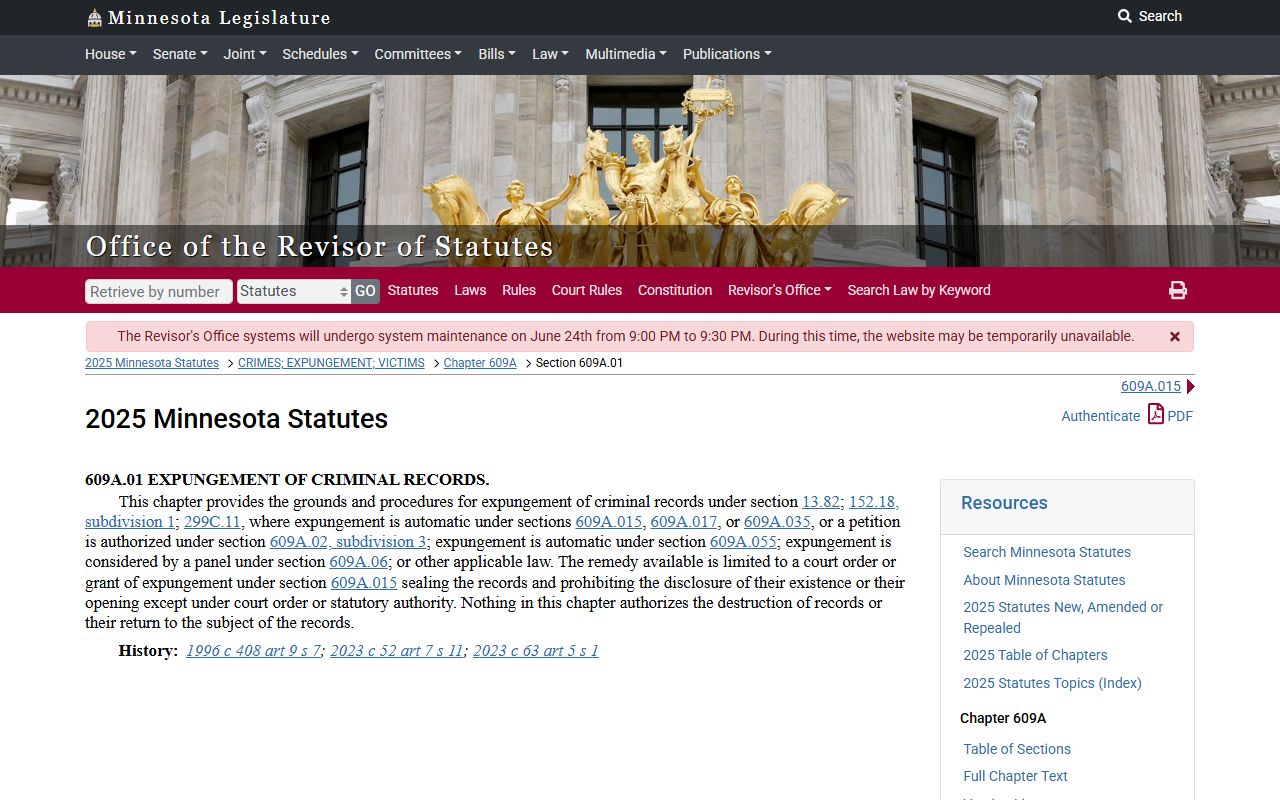
That definition is important because expungement in Minnesota generally seals eligible records rather than erasing every trace of the case.
The next manifest source, Minnesota Statutes section 609A.02, lists expungement grounds.
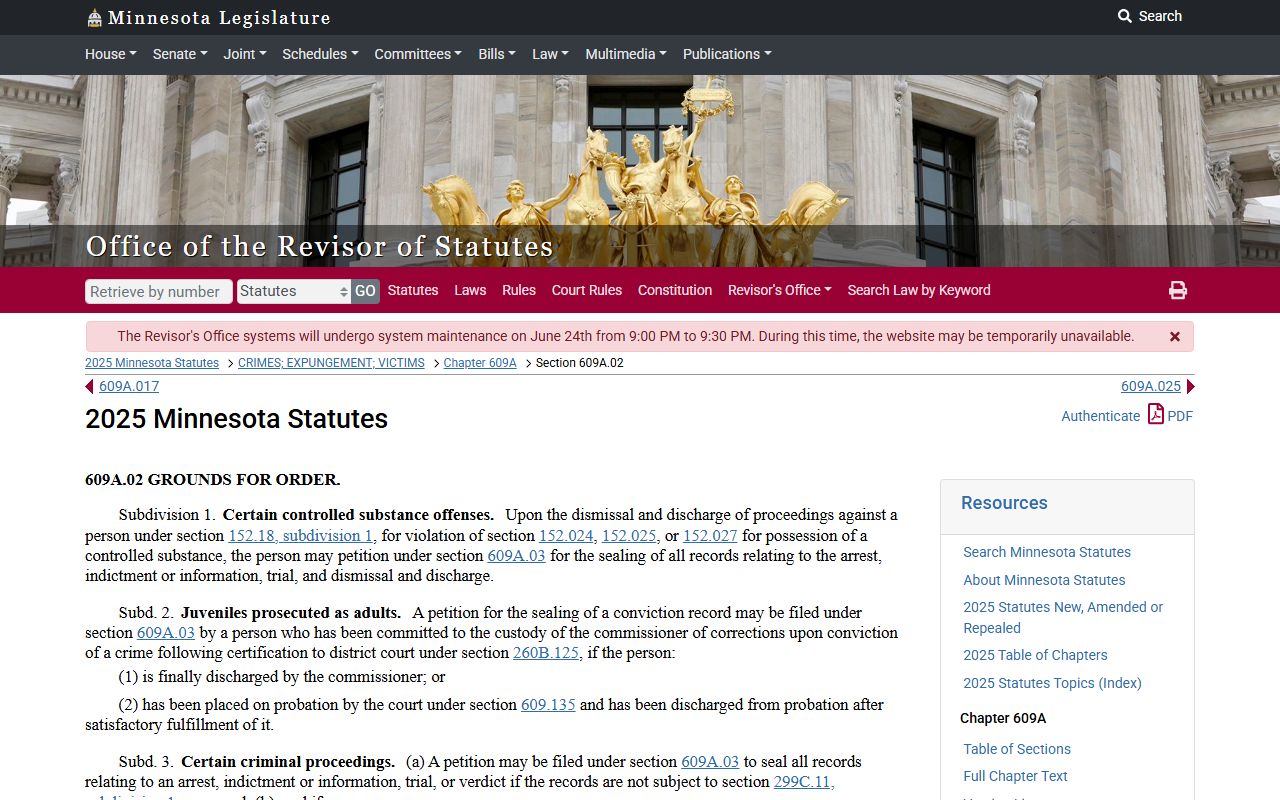
Grounds can depend on the outcome, the offense level, waiting periods, diversion, stay of adjudication, or specified felony rules.
The petition process itself is reflected in the manifest image from Minnesota Statutes section 609A.03.
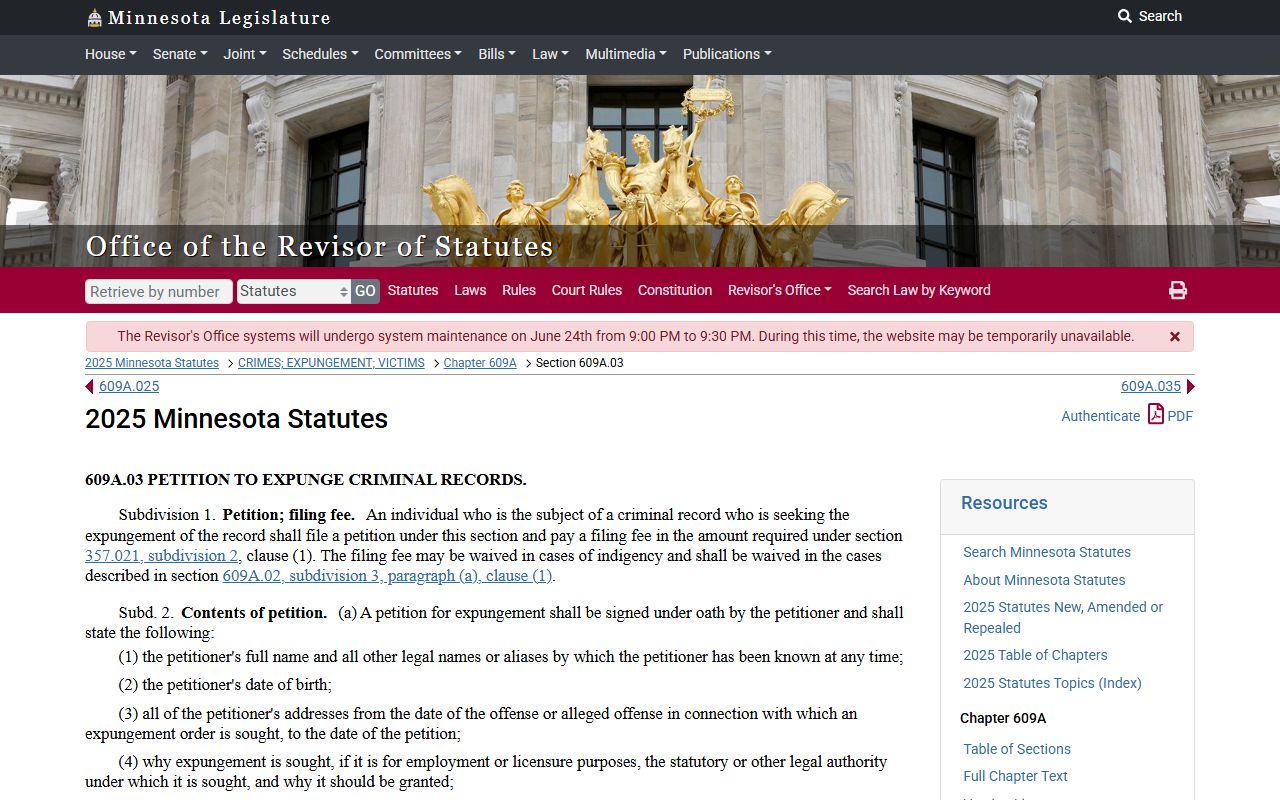
For a Polk County criminal case, an expungement petition is filed in District Court unless another controlling rule applies.
Polk Criminal Copy Requests
For certified criminal court records, contact Polk County District Court Administration at the Justice Center. The research file lists the Court Administration phone as 218-281-2332, fax as 218-281-2204, and hours as Monday through Friday, 8 a.m. to 4:30 p.m. Certified copies generally cost $14 per document under the Polk District Court fee schedule and Minnesota fee authority. Plain online copies may be available at no charge when MCRO provides them.
Polk County Court Administrator
816 Marin Ave, Suite 210
Crookston, MN 56716
218-281-2332
Monday-Friday, 8 a.m.-4:30 p.m.
For public-defense questions tied to a criminal case, the Minnesota Board of Public Defense lists a Crookston satellite office serving Polk County. A public defender may be appointed in misdemeanor, gross misdemeanor, felony, and juvenile delinquency cases with possible jail time if the court finds the person financially eligible.